Palindromic Chess
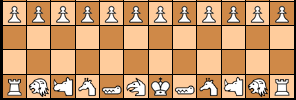
This is an example of a game in which the ending position is the same as the starting position (just rotate the board 180 degrees at the end and you're ready for another game).Initial Array
   +---+---+---+---+---+---+---+---+
 8 |lr | n | b | k | q | b | n | rr|
   +---+---+---+---+---+---+---+---+
 7 | p | p | p | p | p | p | p | p |
   +---+---+---+---+---+---+---+---+
 6 |   |   |   |   |   |   |   |   |
   +---+---+---+---+---+---+---+---+
 5 |   |   |   |   |   |   |   |   |
   +---+---+---+---+---+---+---+---+
 4 |   |   |   |   |   |   |   |   |
   +---+---+---+---+---+---+---+---+
 3 |   |   |   |   |   |   |   |   |
   +---+---+---+---+---+---+---+---+
 2 | P | P | P | P | P | P | P | P |
   +---+---+---+---+---+---+---+---+
 1 |RR | N | B | Q | K | B | N | LR|
   +---+---+---+---+---+---+---+---+
     a   b   c   d   e   f   g   h
Rules
Ortho-chess rules, except:- No capturing is allowed.
- All pieces must move forward (except the rooks, which may move
sideways). Pawns move one square forward orthogonally or diagonally
(same as the King).
- A player's turn consists of two actions. The first action is for the player to move one of their own pieces. The second action is for the player to move an opponent's piece. When moving a one's own piece, the piece must move the maximum possible number of squares. A white Rook on a6 would have to move to h6 (assuming
no intervening pieces on the 6th rank or on the a-file). It could not move to a7 or a8.
This rule was suggested by Alexandre Muñiz. Thanks Alexandre.
- RR is a Right-Handed Rook. When this rook moves sideways, it must move
to the (player's) right.
- LR is a Left-Handed Rook. When this rook moves sideways, it must move
to the (player's) left.
- There is no check or checkmate. See below for winning conditions.
- Castling is not allowed.
- Initial two-square move for pawns is not allowed.
- If a player has no legal move, they pass their turn and play continues. This is the only condition under which a player may pass their turn.
Winning Condition
The player who makes the move such that all the pieces have exactly reversed their positions (ie. white pieces are in the initial black piece positions and vice-versa) wins the game. Or in other words, the first player to move their all their pieces to their destination squares loses (they must pass their turn until the opposing player has moved all his pieces to their destination squares)!It is illegal to make a move that precludes the possibility of any piece of reaching its final destination square. The final destination square of a piece is the starting square of the same type of piece of the opposing player (eg. White's c1 bishop must end up on f8 -- therefore it would be illegal for white to move the c1 bishop to a5).
Note that the destination square of a piece is the starting square of the same type of opponent's piece. So the pawn on a2 has a destination of any of the square on the 7th rank. Right- and Left-handed Rooks are considered to be different types.
Notes
Variations:- First player to move their pieces to their destination squares wins.
- Roll a d6 to determine which piece players must move (1=any piece, 2=pawn, 3=rook, 4=bishop, 5=knight, 6=queen or king). If player can't move the piece specified by the roll, then they may move any piece.
Other properties of this game:
- It has a maximium number of moves:
Each rook takes a maximum of 14 moves to reach its ending square. Each Bishop takes a maximum of 7 moves to reach its ending square. The King and Queen each take a maximum of 7 moves to reach their ending squares. The pawns each take a maximum of 5 moves to reach their ending squares. Each Knight takes at most 5 moves to reach its ending square.
So, 2x14 + 2x7 + 2x7 + 8x5 + 2x5 = 106 / 2 = 53 turns maximum.
- It cannot end in a draw.
- Note that this game is not truly a 'palindrome' in that it isn't the same game played forwards as backwards. Any such game would only be interesting for the first half of the game as all the moves of the second half would be forced!
Written by David Howe.
WWW page created: January 26, 2000. Last modified: January 31, 2000.