The Piececlopedia: Bishop-Knight Compound
Princess, Archbishop, Cardinal, Paladin
Historical remarks
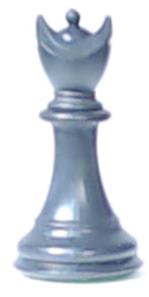
Order the Archbishop on ebay in the Musketeer Chess Variant Kit - Chancellor & Archbishop - Black & White
This piece has a long history and has been called by many names. At present, there is no name it is universally known as, though some come close. Judging by how many games this piece has been given a certain name, the top names for this piece are Paladin, Cardinal, Archbishop, and Minister. But there are other considerations than just number of games. The author of this text, Fergus Duniho, has stuffed the ballot in favor of Paladin by creating several games using that name for this piece. Generally, the most widely used names for this piece are Cardinal, Archbishop, and Princess.
Princess is the standard name for the piece among fairy problemists. This name is used as the favored name in both Dickin's Guide to Fairy Chess and The Oxford Companion to Chess. The rationale behind this name is an analogy with the Queen. This piece, the Queen, and the Rook/Knight compound are the three main compounds of the three simple pieces in Chess, the Rook, Bishop, and Knight. The idea is that, like the Queen, all three of these compounds should be named after female royalty. Since the Bishop is weaker than the Rook, this piece was considered the weaker of the two compounds besides the Queen. So it got the name Princess, while the name Empress went to the Rook/Knight compound. Despite being weaker, the Princess has the advantage of being able to checkmate a King entirely on its own, whereas an Empress requires assistance from another piece to checkmate a King.

The name Archbishop was introduced by Capablanca, who had originally called this piece a Chancellor, perhaps because one of its meanings refers to Roman Catholic clergy. (Chancellor noun 4.) Both of Capablanca's names for this piece suggest some kind of augmented Bishop. For non-Catholics, the name of Archbishop more clearly does this than Chancellor, which to many people may just mean a head of state or a college president. In Grand Chess, Christian Freeling took a similar approach to naming this piece, calling it a Cardinal, which is the highest rank in the Catholic Church short of the Pope. While the ecclesiastical significance of Cardinal is certainly better known to non-Catholics than that of Chancellor, the name Archbishop still has the advantage of being more ecumenical, and this name more clearly suggests an augmented Bishop of some sort. This is evident when we consider what other pieces have been given these names. The name Archbishop has been used for two other augmented Bishops. In A Guide to Fairy Chess, Dickins describes one that moves like a Bishop but also "reflects off one edge of the board like a billiard-ball off a side-cushion" (11). In Diamond Chess, an Archbishop is a piece that moves as a Bishop or a King. In contrast, the name Cardinal is used in the commercial game Cardinal Super Chess for a lame camel, which is given an ecclesiastical name for being colorbound like the Bishop. Both Archbishop and Cardinal have been popular names for this piece. Archbishop has been used in the commercial variant Gothic Chess, which borrowed his its names from Capablanca's Chess, and John William Brown has favored the name Cardinal in his book Meta-Chess.
Despite the popularity of both names, neither one captures the specific compound nature of the piece. Each suggests some kind of augmented Bishop, but neither name suggests any kind of augmented Knight. Yet this piece should be thought of as both an augmented Bishop and an augmented Knight. In Cavalier Chess, Fergus Duniho introduced the name Paladin, which does capture the specific compound nature of this piece. In Advanced Dungeons & Dragons, a paladin is a hybrid character class of the cleric and the fighting man classes. Since Bishops are clerics and Knights are fighting men, the name seems appropriate for a compound of the Bishop and Knight. Curiously, Gary Gygax, the creator of AD&D, used the name for a 3D piece that is similar to the Centaur in his own Chess variant, Dragon Chess. Despite this, Paladin remains an uncommon name for the Centaur, and I have now used the name in several games besides Cavalier Chess, particularly in Fusion Chess and its many derivatives.
One more issue affecting the choice of piece name is what letter is used to notate it. Princess and Paladin both start with P, which is commonly used for Pawns. The notation of Pr or Pl would be suitable for use with these names. Cardinal can be notated with C, but C is often used for Camel, Cannon, and Chancellor, the last of these being a popular name for the piece most commonly used with this piece. The use of A for Archbishop doesn't conflict with any A-names for popular pieces. Another consideration is the name this piece is sold under. The House of Staunton currently sells it under the name of Archbishop for both Camaratta Chess and Gothic Chess.
- Camaratta Chess
- Camaratta Chess Variant Kit - Chancellor & Archbishop Combination - 4 PIECES
- Camaratta Chess Variant Kit Bundled with HOS Luxury Plastic Chess Pieces
- Gothic Chess
This table gives an overview of the history of this piece.
| Year | Game | Name of Piece | Creator of Game | 14th century? | Shatranj Al-Kabir (Great Chess) | Unknown |
|---|---|---|---|
| 1617 | Carrera's Chess | Centaur | Pietro Carrera |
| <= 18th century | Turkish Great Chess | Wazir | Unknown |
| 1840 | The Emperor's Game | Adjudant | L. Tressan |
| 1840 | The Sultan's Game | Adjudant | L. Tressan |
| 1874 | Bird's Chess | Equerry | Henry Bird |
| 1920's | Capablanca Chess | Chancellor / Archbishop | J. R. Capablanca |
| <= 1943 | Wolf Chess | Fox | Dr. Arno von Wilpert(?) |
| 1968 | Modern Chess | Minister | Gabriel Maura |
| 1950-1975? | Cagliostro's Chess | Archbishop | Savio Cagliostro |
| 1978 | Tutti-Frutti Chess | Princess | Ralph Betza and Philip Cohen |
| 1980 | Renniassance Chess | Archbishop | Eric V. Greenwood |
| 1984 | Grand Chess | Cardinal | Christian Freeling |
| <= 1996 | Janus Chess | Janus | Stephan Blasius(?) |
| 1996 | The Colorbound Clobberers (CDA) | NB | Ralph Betza |
| 1997 | Cobra Chess | Vizir | Derick Peterson |
| 1997 | Grand Hexachess | Vizir | Derick Peterson | 1998 | Euchess | Cardinal | Carlos Cetina |
| <= 1998 | Chess 2000 | Knight/bishop | Gerhard Josten |
| 1998 | Eric's Great Chess | Vizir | Eric Greenwood |
| 1998 | Pre-Grand Chess | Cardinal | Eric Greenwood |
| 1998 | Hammer Chess | Bishop | Jim Aiken |
| 1998 | Cavalier Chess | Paladin | Fergus Duniho |
| 1999 | Haynie's Great Chess | Cardinal or Archbishop | Billy Haynie |
| 1999 | Pick-the-Team Chess | Cardinal | Hans Bodlaender |
| 1999 | Hexmate | Paladin | Michael A. Rouse |
| 1999 | Grand Cavalier Chess | Paladin | Fergus Duniho |
| 1999 | Bedlam | Paladin | Fergus Duniho |
| 1999 | Metamorphin' Fusion Chess | Paladin | Fergus Duniho |
| 1999 | Fusion Chessgi | Paladin | Fergus Duniho |
| 1999 | Fusion Chess | Paladin | Fergus Duniho |
| 1999 | Metamorph Chess | Paladin | Fergus Duniho |
| 2000 | Giant Chess | Minister | Köksal Karakus |
| 2000 | Perfect Chess | Minister | Köksal Karakus |
| 2000 | Terror Chess | Cardinal | Brian Wong |
| 2000 | Turkish Chess | Minister | Köksal Karakus |
| 2000 | 4 Armies | Cardinal | Patrick Riley |
| 2000 | Trihex | Cardinal | Marek 14 |
| 2000 | The Knightliest Black Hole | Count | João Pedro Neto |
| 2000 | Drop Chess | Crusader | Key McKinnis |
| 2001 | Twenty-First Century Chess | Baron | Karl Munzlinger |
| 2000 | Fantasy Grand Chess | Cardinal | Peter Hatch |
| 2001 | Gigachess | Cardinal | Jean-Louis Cazaux |
| 2002 | Abecedarian Big Chess (ABChess) | Archbishop | Glenn Overby |
| 2002 | Full Double Chess | Cardinal | Sergey Sirotkin |
Movement rules
This piece may move like an orthodox chess Bishop, or like an orthodox chess Knight.
Movement diagram
The blue circles indicate the leaping moves of a Knight, while the green circles indicate the Bishop move.
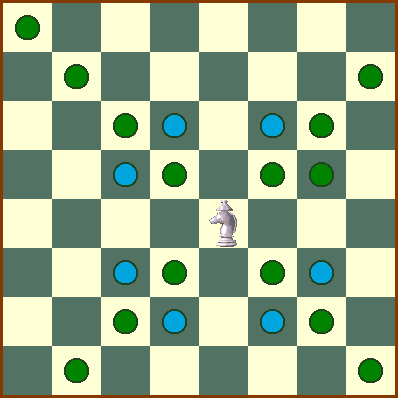
and the Meta-Chess movemap below:

Notes
This piece can generally force checkmate against a bare king, with the help of its friendly king. Try it!Alternate Images
Click on an image to view the full piece set it belongs to.
 |
 |
 |
 |
 |
 |
 |
 |
 |
This is an item in the Piececlopedia: an overview of different (fairy) chess pieces.
Written by Fergus Duniho and David Howe.
The Meta-Chess move map was reprinted from Meta-Chess, copyright 1997, by permission of John William Brown. One sentence added by Hans Bodlaender.
Movement diagram and piece icon created from Zillions of Games
WWW page created: February 12, 1999.